A village that puts safety first when harvesting wild honey at height
Kampung Long Ayap
Kampung Long Ayap is a village in Segah District, in the upper reaches of Berau Regency, around the headwaters of the Segah River. From the regency capital Tanjung Redeb, Long Ayap is about 230 km away by car or motorbike: around 2 hours on paved road to Segah District (Tepian Buah), or 1.5 hours by motorbike, and then about 3 hours (2-2.5 hours by motorbike) on dirt roads through oil palm plantations from Segah District to Long Ayap.
The village stretches from south to north. Its land covers 38,184 ha, including 13,605 ha of protection forest. The village came into being through several moves, a characteristic of the Dayak Punan people. The place where they live now is where they have settled and modernised, with access by both river and road. Some sources say their ancestors originally lived at the headwaters of the Long Okeng, or in Segah. After a long process of moving, they later settled in Gutol Nlung.
The name Long Ayap comes from a river at the headwaters where the community also once lived. The place they live now is called Jo'jakang, but because the name Kampung Long Ayap was already registered with the government at the time, it is still used today. Long Ayap lies close to the equator, so it has a tropical climate with high rainfall spread evenly through the year. Strong sunshine gives Long Ayap relatively high air temperatures, together with high humidity.
Long Ayap is rich in natural resources, including non-timber forest products such as Segah rattan (ronti), wild honey (Apis dorsata), pasak bumi, onlong, sthi leaves, cungkanla leaves, wild terap (“kumut”) and others. With extensive forest cover and a strong awareness of the importance of keeping the forest sustainable, the community has built a collective vision: Emhui Tna = Emhui Lasngan Blom, in the Dayak Mapnan language, meaning “protecting the forest is protecting the breath of life”. This led to the founding of the Long Ayap Village Forest Management Institution (LPHD), established by decree SK.526/Menlhk-PSKL/PKPS/PSL.0/2/2017 of 14 February 2017, covering 5,640 ha of protection forest.
Wild honey and the mangris tree
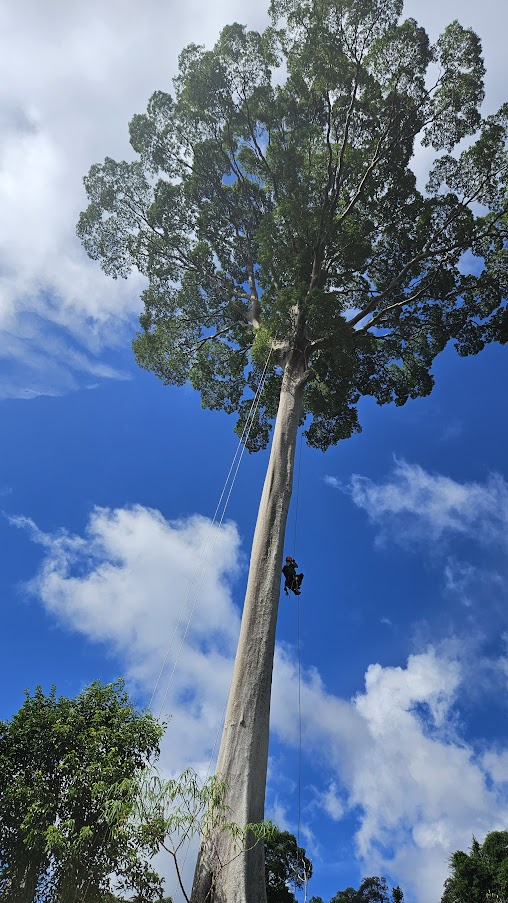
The mangris or banggeris tree (Koompassia excelsa), a member of the Fabaceae family, is one of the tallest trees in the tropical rainforest. It can grow to more than 80 m, making it an emergent species. The tree has a beautiful trunk. Banggeris produces good-quality hardwood of considerable economic value. Even so, most Dayak customary communities strictly forbid felling it and regard it as taboo, a clear example of Dayak local wisdom in forest conservation.
Because banggeris grows so tall and has such a hard trunk, it is an ideal nesting site for honey bees in Borneo, especially the species Apis dorsata binghami. Nesting high up keeps the combs safe from predators such as the sun bear (Helarctos malayanus). Apis dorsata binghami is widespread across Kalimantan (Indonesia), Sarawak and Sabah (Malaysia). Its honey is highly nutritious, containing various sugars and minerals such as potassium, iron, calcium and magnesium.
Honey, as a non-timber forest product, has long been believed to bring many benefits to people and nature. Many scientific studies show that honey from wild bee colonies (Apis dorsata) is an indicator of healthy forest, because wild bees play an important role in pollinating forest plants, allowing forest vegetation to keep growing naturally; other plants also depend on bees as pollinators to reproduce. Apis dorsata usually nests in mangris (Koompassia excelsa) and in other species such as Baccaurea sp., Artocarpus sp., kempas (Koompassia malaccensis) and tempura (Dipterocarpus gracilis).
For Dayak customary communities, honey is an irreplaceable necessity. Besides using it themselves, they sell it at an attractive price. Its high value has led some Dayak people to claim ownership of individual mangris trees, so that others cannot take the honey. Taking honey without permission, or felling the tree, can be punished under customary law with a heavy fine or other sanctions, depending on each group's customs.
Wild honey (Apis dorsata) from Berau, East Kalimantan, meets the Indonesian national honey standard SNI 8664-2018, with a water content of 20.19% w/w, ash content of 0.45% w/w, HMF of 28.91 mg/kg, 43.47 milliequivalents/kg, and reducing sugars of 68.21% w/w. Its health benefits and very attractive price are seen as one reason why felling banggeris is so strictly forbidden. The rule is so strong that logging, mining and plantation companies operating near Dayak communities must also follow it. So don't be surprised if, in the middle of a logged area, one or two trees are still standing completely untouched: they may well be banggeris.
Forest destruction destroys the habitat where honey bees nest and collect nectar to make honey. In ecological terms, conserving a habitat means conserving the forest and everything in it. The vegetation that makes up the habitat is part of one ecosystem with the honey bees, as their source of nectar.
In Berau, East Kalimantan, people call Apis dorsata “unyai”. Unyai usually nests in manggeris trees (Koompassia excelsa). According to 2014 data from the Adviser for Community Based Forest Management at GIZ FORCLIME, “dozens of nests can be found on each tree. In the harvest season, each nest produces between 5 and 20 litres of honey.”
West Berau is the main producer of unyai honey, specifically the area of the West Berau Production Forest Management Unit (KPHP Berau Barat). According to KPHP Berau Barat data from 2014, the area's wild honey potential is 10-30 tonnes per harvest season. According to the 2018 KPHP data on building community-based forestry enterprise, 36 KPHPs in Indonesia have wild honey potential as a non-timber forest product, producing up to 5,787.806 tonnes of wild honey a year.
A 2016 study by Rana Experimental and TNC showed that the wild honey potential of 17 villages in 4 priority districts (Kelay, Segah, Gunung Tabur and Biduk-Biduk) reaches 19,800 litres a year, showing that Berau Regency has very large wild honey potential.
According to the 2017 TFCA-Kalimantan report mapping non-timber forest product potential, wild honey is Berau's star product because it makes a significant contribution to community income. The literature puts the economic value of wild honey from a single tree at up to Rp 30,000,000 a year, and a tree can keep producing for decades. That means a standing banggeris tree is worth more than its timber. According to the August 2017 report on planning the management of wild honey as a leading non-timber forest product in Berau Regency, at least 20 villages in the regency have wild honey potential, spread from the remote interior upstream to the coast downstream. Together these 20 villages produce up to 20,000 litres a year, selling at between Rp 75,000 and Rp 250,000 per litre depending on the size of the harvest, the location and the distance to consumers. Besides honey, products made from the combs also have considerable economic value but are not yet used by communities in Berau. Processing the combs into wax is an additional opportunity, with a good selling price of Rp 40,000-70,000 per kg.
Interviews in Kampung Long Ayap in 2024 found that a single tree holds at most 10 combs, with honey selling at Rp 300,000 per litre, while the combs can be processed into beeswax. In the past, a tree could hold up to 40 combs, because there were still many fruit trees to feed the bees.
Tree-climbing training
The chair of the Indonesian Forest Honey Network (JMHI) has said that in several parts of Indonesia, honey is a leading commodity that contributes to local wellbeing. “Honey is part of the social identity of several customary communities, who keep their forests standing through sustainable honey production. Honey is generally harvested, by climbing, in traditional ways.”
Long Ayap is one of the villages that produce wild honey, which is one of their livelihoods. Until now, however, honey has been harvested traditionally without safety equipment, which carries a high risk of accidents at work.
In a focus group discussion, the Long Ayap community explained that the risks of harvesting honey are serious. Climbers must be highly trained and experienced, because a misjudgement while climbing a honey tree, or being unable to withstand bee stings, can cause a fall from height.
“Not everyone in Long Ayap can climb trees to collect wild honey, only a few who are trained, and young people today are afraid of heights, especially without equipment,” said Pak Saming, head of LPHD Long Ayap.
In response to the wishes of the Long Ayap community, PT Mulia Inti Perkasa (MIP), working with Yayasan Hylobates Awara (YAHYWA) as part of the Segah Integrated Area Development (IAD), carried out capacity building for the villages it supports by providing tree-climbing equipment and tree-climbing training as a safe way to harvest wild honey.
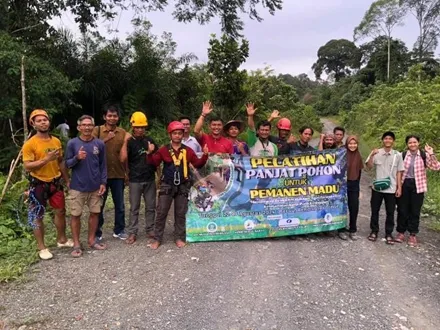
Besides the technical training, the company also provided 2 (two) sets of tree-climbing equipment: static kernmantle rope (400 metres), harnesses, ascending and descending devices (zigzag + chicane), carabiners, a foot ascender, a knee ascender and webbing. They were handed over to LPHD Long Ayap so they can be put to full use.
The training, held on 21-22 August 2024, was led by trainers from Tree Climbers Indonesia (TCI), with 11 participants. Representatives of KPHP Berau Barat also attended.
Tree Climbers Indonesia (TCI) has been a team of professional tree climbers since 2007, with the knowledge (understanding the characteristics of trees), skills, methods and techniques to climb trees comfortably and safely at work.
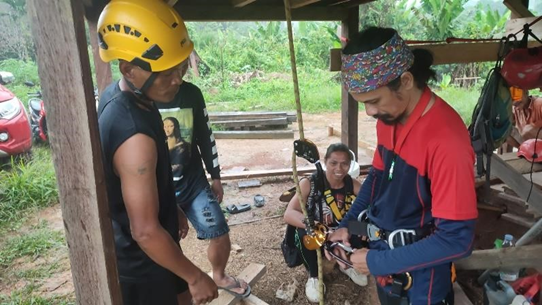
The course began with an introduction to tree-climbing equipment, what each item does and how to look after it, tying knots and hitches, signals and communication, procedures before climbing (inspection of PPE, the tree and the site), installing the main kernmantle rope and throwing the throwline (rope installation and throwing), upper and lower anchor techniques (anchor systems: basal, canopy), ascending and descending (tree access), branch walking (limbwalking), work positioning with a lanyard to climb honey trees easily and safely, and finally checking equipment when leaving the tree (clearing and equipment checks).
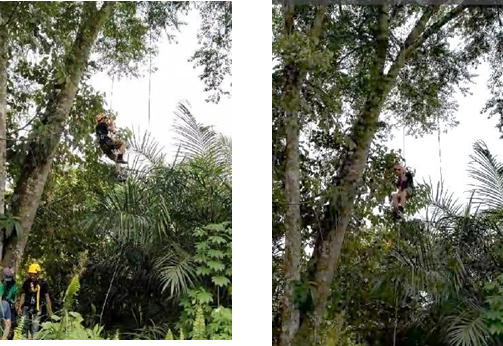
On the first day, participants were very enthusiastic, as it was their first experience of using tree-climbing equipment. For ascending, the training focused on one technique, rope walking. There are many tree-climbing techniques, so why this one? Because with it participants can climb up and down without changing equipment, quickly, and can switch to branch walking (again without changing equipment), which matters because wild honey combs are usually on distant branches. Safety with a lanyard was not forgotten either.
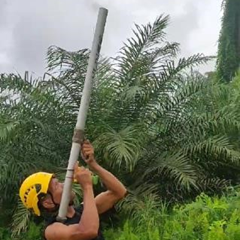
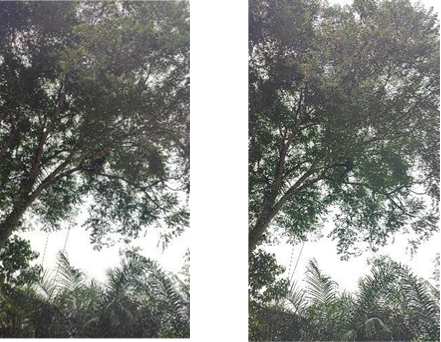
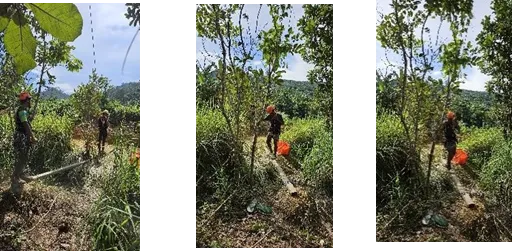
The second day was a practical exam, in which participants had to put on their own safety equipment and tie knots without help from the trainers. The exam tree was a menggeris (Koompassia excelsa) about 40 metres tall. Participants themselves did the throwing stage, using an APTA (Air Powered Tree Access) to reach a branch at about 22 metres, and set up the lower anchor. Rain interrupted the training, so the practical exam continued indoors.
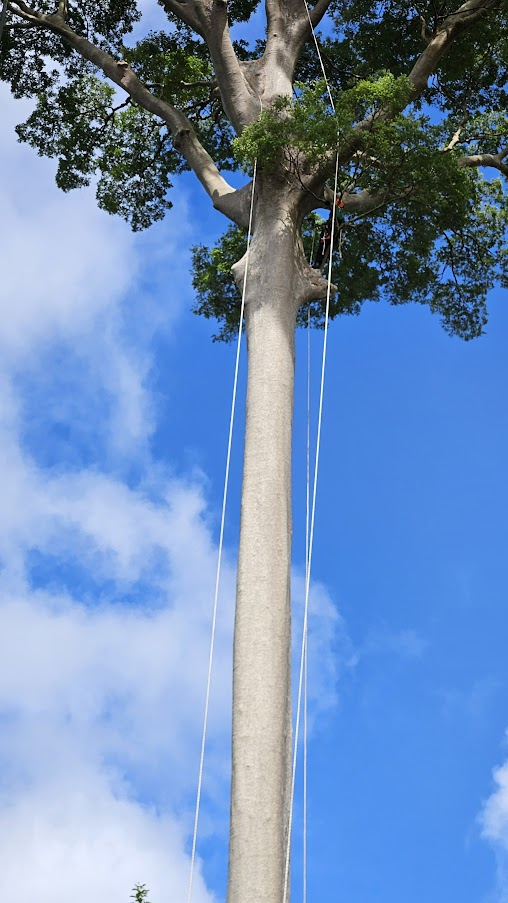
Pak Niklaus Wahyu, Section Head Sustainability at Widya Corporation, representing PT Mulia Inti Perkasa (PT MIP), said that the activity reflects the company's commitment to and concern for the community and honey farmers around its operations, so that they can work safely and obtain the most honey sustainably.
The village head, Pak Jimmy, agreed: “With this training, I hope young people will be keen to harvest wild honey, because I have tried this equipment myself, so the work is more effective and the risk of accidents when harvesting honey can be minimised,” said Jemi. Pak Ario, representing Yayasan Hylobates Awara, echoed this. Pak Joni, representing KPHP Berau Barat, said the activity was very good and should be developed in other villages that produce wild honey, because safety is what matters most.
Eko Pahrudin (TCI instructor) said: “There are many cases in Indonesia of people falling while harvesting wild honey, so this training is essential because the risk of falling is high, and there is still very little support for the upstream side of wild honey production, including training in working at height when harvesting.”
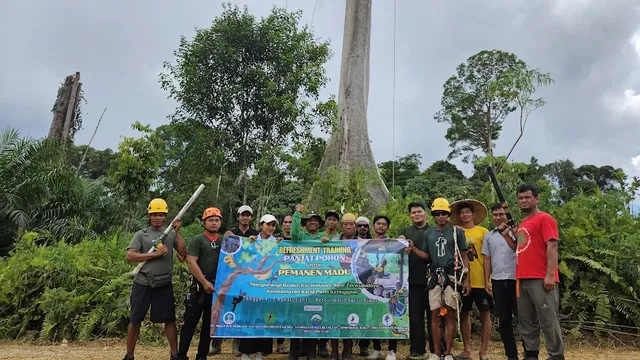
LPHD Long Ayap felt that the previous year's training (2024) had not been enough, especially on branch walking (limbwalking) on horizontal and vertical branches. This technique is crucial because the combs hang on branches or branch tips, and distant branches offer nothing to hold on to, so climbers need techniques for moving along branches and returning to the trunk (movement and work in the tree: techniques to improve returning to the trunk). PT MIP and YAHYWA therefore invited TCI back for a refresher tree-climbing training on 4-5 August 2025, with 6 participants. Representatives of KPHP Berau Barat also attended.
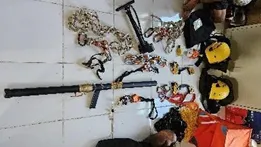
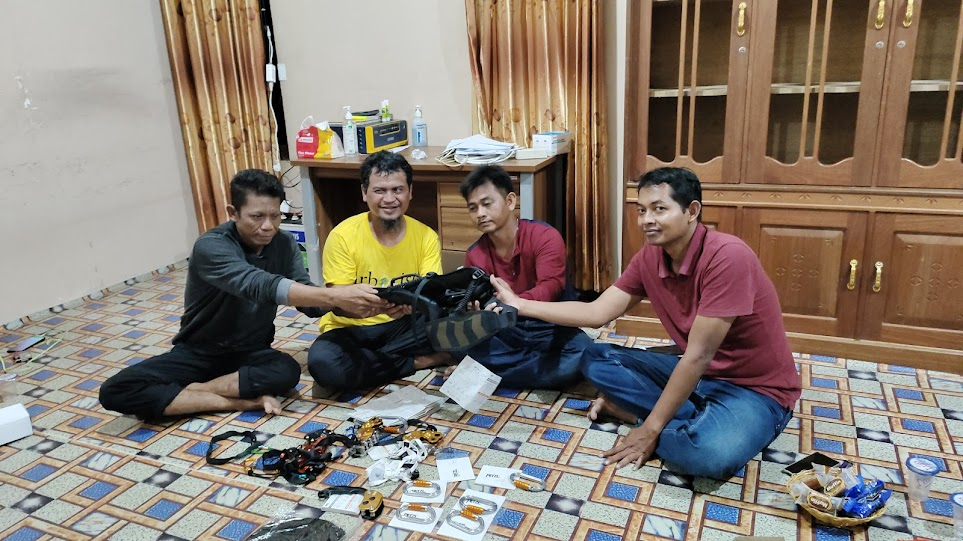
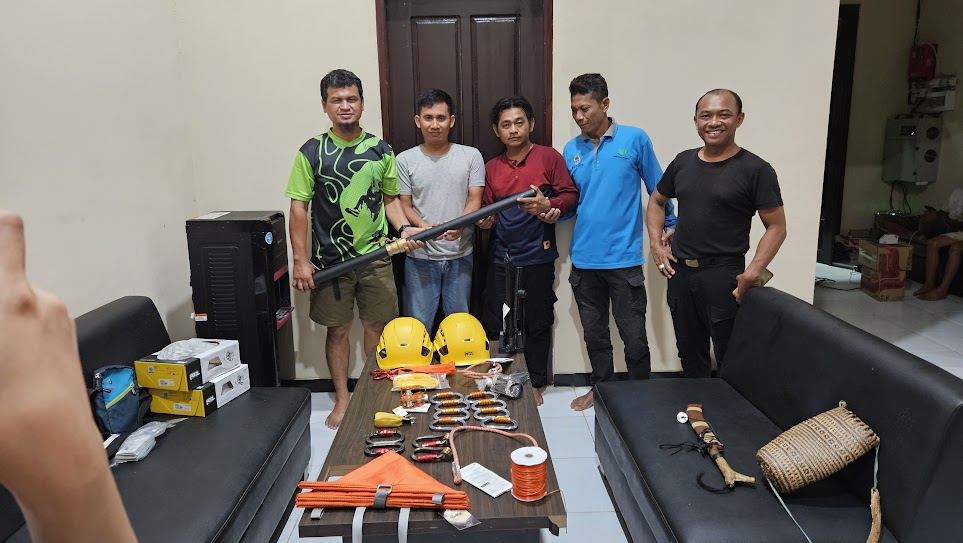
To complete the tree-climbing kit, PT MIP and YAHYWA handed over additional equipment: lanyards, carabiners, pulley carabiners (rollclip), helmets, and a throwing set (throw weight, throw line, throw cube, and an APTA air powered tree access “bazooka” with pump). The village's tree-climbing kit is now complete, perhaps the most complete of any village in Indonesia, especially among wild honey harvesting villages.